
How Impeller Design Affects Water Pump Efficiency
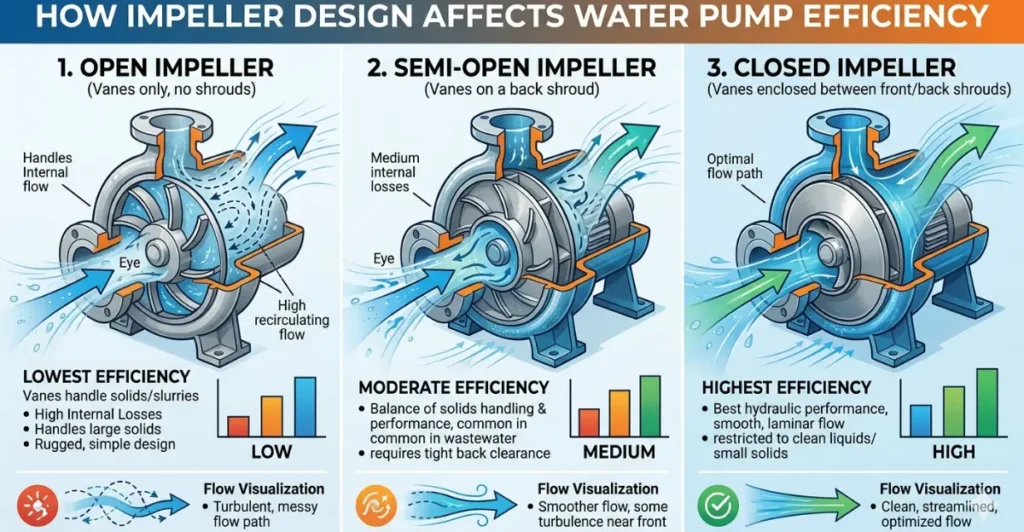
When people buy a water pump, they usually look at power, price, or brand name. But one very important part is often ignored — the impeller.
The impeller is the main part inside the pump that moves water. Its design directly affects water flow, electricity usage, pressure, and overall performance.
In simple words, if the impeller design is good, the pump works smoothly and saves energy. If the design is poor, the pump wastes electricity and creates problems.
This is why understanding how impeller design affects water pump efficiency is very important before choosing a pump.
What is an Impeller in a Water Pump?
An impeller is a rotating part inside the pump.
Its job is simple — it spins and pushes water forward. This movement creates pressure and helps water travel from one place to another.
You can think of it like a fan blade inside the pump. But instead of moving air, it moves water.
The shape, size, and design of the impeller decide how efficiently the pump works.
Why Impeller Design Matters
Many people think all pumps work the same way. But even small changes in impeller design can change pump performance completely.
A properly designed impeller helps the pump:
- Move water faster
- Use less electricity
- Reduce noise and vibration
A poor design can lead to low water flow, energy loss, and frequent breakdowns.
This is why good manufacturers focus heavily on impeller engineering.
How Water Pump Efficiency Works
Water pump efficiency means how well the pump converts electrical energy into water movement.
A high-efficiency pump gives better water flow with less power consumption.
The impeller plays a major role in this process because it controls water movement inside the pump.
If water flows smoothly through the impeller, energy loss becomes lower. This improves efficiency.
Types of Impeller Designs
Different pumps use different impeller designs depending on the application.
Open Impeller
Open impellers have visible blades.
They are simple in design and mainly used for handling water with small particles or impurities.
They are easy to clean but slightly less efficient compared to closed designs.
Closed Impeller
Closed impellers are covered from both sides.
These are highly efficient and commonly used in clean water pumps.
They provide better pressure and smoother operation.
Semi-Open Impeller
Semi-open impellers are a combination of both designs.
They balance efficiency and flexibility, making them useful in many applications.
Blade Shape and Pump Performance
The shape of the impeller blades directly affects water movement.
Curved blades help water flow smoothly and reduce turbulence. This improves efficiency and reduces energy loss.
If blade design is poor, water movement becomes uneven. This creates vibration, noise, and power wastage.
A well-designed blade system helps maintain stable water pressure.
Impeller Size and Efficiency
Impeller size also matters.
A larger impeller can move more water, but it also requires more power. A smaller impeller may save energy but may not provide enough pressure.
This is why pump manufacturers carefully select impeller size according to the pump application.
Choosing the wrong size affects both efficiency and performance.
Material Used in Impellers
Impeller material affects durability and long-term efficiency.
Good quality materials resist wear and corrosion. This keeps the pump performance stable for years.
Low-quality materials wear out faster, reducing efficiency over time.
Trusted manufacturers use durable materials to improve pump life and performance.
Connection Between Impeller Design and Electricity Consumption
One of the biggest benefits of a good impeller design is lower electricity consumption.
When water moves smoothly inside the pump, the motor works with less effort. This reduces power usage.
Poor impeller design creates resistance and turbulence. This forces the motor to work harder and increases electricity bills.
This is why energy-efficient pumps focus on optimized impeller design.
Overheating Issues Caused by Poor Impeller Design
Many users face overheating issues in water pumps without understanding the real reason.
Sometimes the motor is blamed, but the actual problem is poor water flow inside the pump caused by inefficient impeller design.
When the impeller creates extra resistance, the motor works harder and generates more heat.
Over time, this can damage internal components and reduce pump life.
Importance of Motor Winding Quality
Even with a good impeller, the pump needs a strong motor to perform efficiently.
Motor winding quality plays a major role in overall pump performance.
High-quality winding improves energy transfer and reduces heat generation.
Poor winding can lead to low efficiency, overheating, and frequent motor failure.
This is why good manufacturers focus on both impeller design and motor quality together.
Role of Water Pump Maintenance
Proper water pump maintenance is important for maintaining impeller efficiency.
Dust, dirt, or rust inside the pump can affect impeller movement. This reduces water flow and increases electricity usage.
Regular cleaning and checking help maintain smooth operation.
Ignoring maintenance can reduce pump efficiency even if the impeller design is good.
Signs of Poor Impeller Performance
Some common signs indicate that the impeller is not working properly.
Low water pressure is one of the first signs. Increased electricity bills are another common problem.
Noise and vibration also occur when water flow becomes unstable.
Sometimes, the pump may start overheating or losing efficiency slowly.
These signs should not be ignored.
How Good Manufacturers Improve Efficiency
A professional manufacturer does not design pumps randomly.
Every part of the pump is tested carefully, especially the impeller.
Manufacturers analyze water flow, pressure, and energy usage before finalizing the design.
This helps create pumps that deliver stable performance with low power consumption.
Why Choosing the Right Water Pump Supplier Matters
A reliable water pump supplier helps you choose the correct pump according to your requirement.
Different applications need different impeller designs.
For example, a domestic water pump requires different performance compared to an industrial or agricultural pump.
A trusted supplier understands these differences and guides customers properly.
Common Mistakes People Make
Many people buy pumps based only on horsepower or price.
But ignoring impeller design often leads to poor performance later.
A cheap pump may save money initially, but it can increase electricity costs and maintenance expenses in the long run.
That is why overall design quality matters more than just price.
How CK Pumps Focuses on Better Efficiency
CK Pumps focuses on designing pumps that deliver high efficiency and reliable performance.
The pumps are built using quality impeller designs and strong motor systems.
Every product is tested to ensure smooth water flow, low power consumption, and long life.
This helps customers get better performance with fewer maintenance issues.
Choosing the Right Pump for Your Requirement
The best pump is not always the most powerful one.
It is the one that matches your water requirement properly.
Factors like water depth, pressure, and daily usage should always be considered.
A properly selected pump works efficiently and lasts longer.
Conclusion
Understanding how impeller design affects water pump efficiency helps you make a smarter buying decision.
The impeller is one of the most important parts of a pump. Its design controls water flow, energy usage, pressure, and overall performance.
A good impeller design improves efficiency, reduces electricity bills, and prevents overheating issues.
Along with proper design, factors like motor winding quality and regular water pump maintenance also play an important role.
Instead of focusing only on price, always choose a pump designed for long-term performance and efficiency.
A high-quality water pump is not just about moving water — it is about doing it smoothly, efficiently, and reliably for years.