
Inside a Water Pump Factory: What Quality Really Looks Like
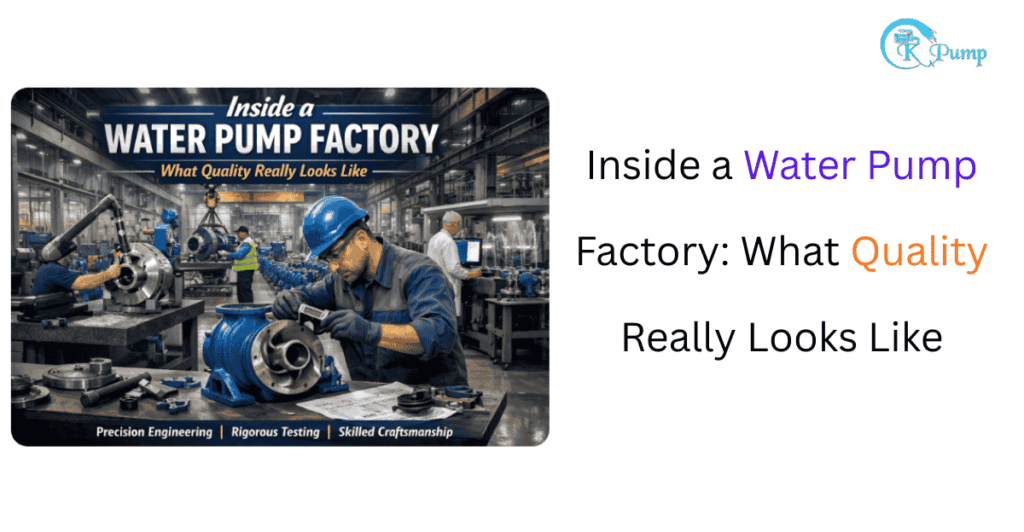
Most people judge a water pump by one simple question: “Kitna saal chalega?”
But very few people ever see what actually decides that answer — the factory where the pump is made.
From the outside, a water pump factory may look like a noisy industrial space filled with machines and workers. But step inside, and you’ll quickly realize that real quality is not about machines alone. It’s about processes, discipline, testing habits, and the mindset of the people building the pump.
This article takes you inside a real water pump manufacturing environment to explain what quality truly looks like — beyond brochures, specifications, and price tags.
Quality in a Water Pump Starts Long Before Manufacturing
A common misconception is that quality is checked at the final stage. In reality, quality begins at the design table.
Inside a serious water pump factory, engineers first focus on:
Application requirements (domestic, agriculture, industrial)
Water conditions (sand content, voltage fluctuation, duty cycle)
Energy efficiency and motor compatibility
Long-term wear and serviceability
At manufacturers like CK Pump, pump design is not copied blindly. Each model is engineered based on Indian water conditions, fluctuating power supply, and real-world usage — not lab-perfect assumptions.
If the design is weak, no amount of polishing later can save the product.
Raw Material Selection: Where Most Fail, and Quality Brands Don’t
This is where real separation happens.
Inside a quality-focused water pump factory, raw materials are not purchased based on price alone. They are selected based on:
Metal composition
Casting density
Corrosion resistance
Heat tolerance
Long-term fatigue strength
For example:
Submersible pump bodies need casting that can handle constant water pressure.
Shafts must be precisely aligned and hardened to avoid vibration.
Copper windings must meet purity standards to prevent overheating.
Factories that compromise here often hide it well — until pumps start failing within a year.
Precision Manufacturing Is Not Optional Anymore
Once raw material enters the production floor, precision becomes everything.
Inside a modern water pump factory:
CNC machines ensure accurate dimensions
Shaft alignment is measured in microns
Impellers are dynamically balanced
Motor housings are machined to avoid air gaps
Why does this matter?
Because even a small imbalance can:
Increase vibration
Reduce bearing life
Waste electricity
Cause early motor failure
Quality manufacturers don’t rush this stage. They’d rather slow production than allow inconsistency.
Motor Winding: The Silent Determiner of Pump Life
Ask any experienced technician — motor winding quality decides everything.
Inside a trusted water pump factory:
Only high-grade copper wire is used
Proper insulation class is followed
Winding tension is controlled
Heat resistance is tested
Cheap factories often reduce copper content or mix alloys. The pump may run initially, but overheating becomes inevitable.
This is why pumps from quality manufacturers like CK Pump tend to:
Consume less power
Run cooler
Survive voltage fluctuations
Last longer without rewinding
Assembly Is a Skill, Not Just a Step
Assembly is where experience matters more than machines.
Inside a serious factory:
Bearings are pressed with correct load
Seals are fitted to prevent micro-leakage
Fasteners are torqued to exact specifications
Electrical connections are double-checked
Here, human skill directly affects reliability.
One wrong bearing fit or seal alignment can reduce pump life by years. That’s why skilled technicians — not untrained labor — are essential to quality manufacturing.
Testing: Where Claims Are Either Proven or Exposed
This is the stage most customers never see — but should care about the most.
A genuine water pump factory tests every pump, not just random samples.
Testing typically includes:
Hydraulic performance testing
Flow rate and head verification
Load and current consumption checks
Noise and vibration monitoring
Leak and pressure endurance testing
At CK Pump, testing is not treated as a formality. Pumps that don’t meet internal benchmarks never leave the factory, even if they “technically work.”
That discipline is what separates dependable brands from short-term sellers.
Quality Control Is a System, Not One Department
In low-end factories, quality control is one table at the end of the line.
In a quality-driven water pump factory, QC exists:
At raw material entry
During machining
After motor winding
During assembly
Before final packing
Each stage has checklists, tolerances, and accountability.
This layered approach ensures that defects are caught early — when they are still fixable.
Documentation and Traceability Matter More Than You Think
Another invisible but critical factor is manufacturing documentation.
Quality factories maintain:
Batch records
Material traceability
Test reports
Model revision histories
Why does this matter?
Because when a field issue occurs, the manufacturer can identify root cause, not just replace the pump blindly.
This level of maturity is common in established manufacturers — and rare among copy-paste operations.
Packaging and Dispatch Reflect Manufacturing Mindset
Even packing tells a story.
Inside a professional water pump factory:
Pumps are cleaned before packing
Moisture protection is used
Wiring terminals are sealed
User manuals and installation guides are included
Poor packaging often indicates poor internal discipline. A factory that doesn’t respect its finished product usually didn’t respect the process either.
What Quality Really Looks Like in the Real World
When you step back, quality inside a water pump factory is not one big feature.
It’s a combination of:
Thoughtful design
Honest material sourcing
Precision machining
Skilled assembly
Relentless testing
System-driven quality control
Manufacturers like CK Pump have built their reputation by focusing on these fundamentals — not shortcuts or loud marketing.
Final Thought: Why This Matters to Buyers
If you’re choosing a water pump only by price, you’re gambling.
But if you understand what quality looks like inside a factory, you start asking better questions:
Who made it?
How is it tested?
What materials are used?
Is the manufacturer accountable?
A water pump is not just a product.
It’s a system that should work silently for years.
And that reliability is always born inside the factory, long before the pump reaches your home, farm, or industry.