GET INSTANT ONLINE QUOTATION ON WHATSAPP :  

+91 79848 29257

How to Calculate LPM of Water Pump

How to Calculate LPM of Water Pump

How to Calculate LPM of Water Pump - Ck Pump

What is LPM in a Water Pump?

When people buy a water pump, many only check HP or motor size. But one important thing that tells you how much water your pump can actually deliver is LPM.

LPM means Liters Per Minute.

Simply, LPM tells us:

How many liters of water a pump can move in one minute.

If a pump gives 50 liters every minute, then its flow rate is 50 LPM.

Knowing how to calculate LPM of water pump helps you choose the correct pump for home, agriculture, industry, construction work, or commercial applications.

If you choose the wrong flow rate, you may face:

  • Low water supply
  • Wasted electricity
  • Higher operating costs
  • Poor pump performance

This is why understanding pump flow rate calculation becomes important before purchasing.
Why Should You Calculate Water Pump LPM?

Many people ask:

“Why do I need to calculate pump capacity?”

The answer is simple.

Different work needs different water flow.

For example:

A small house water supply may require lower LPM.

Agricultural irrigation may require much higher flow.

Industrial applications may require large water volume continuously.

If your pump flow is too small, work becomes slow.

If the pump flow is too large, power consumption increases unnecessarily.

So calculating water flow rate helps you choose correctly.

Understanding Water Pump Flow Rate

Before learning calculations, understand one simple thing.

A pump performance mainly depends on:

Water Flow

How much water moves.

Head Height

How high water must travel.

Pipe Size

Bigger pipes affect flow differently.

Motor Power

Motor size impacts output.

Flow rate and pressure work together.

Higher head often reduces flow.

Lower head usually increases flow.

This is why manufacturers mention pump curves and specifications.

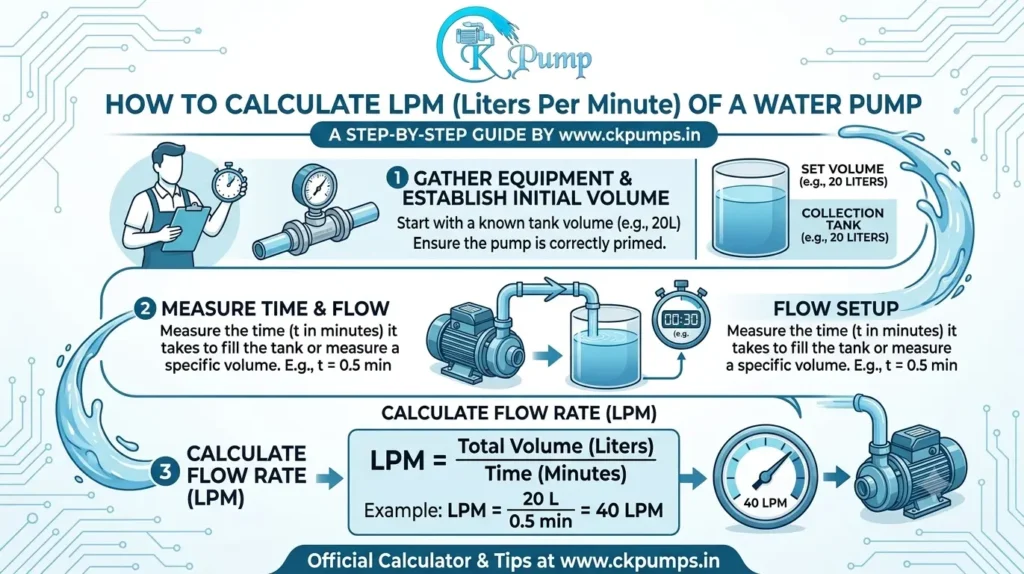
Basic Formula to Calculate LPM of Water Pump

The easiest formula is:

LPM

This means:

Measure how much water is collected.

Measure time.

Divide water quantity by time.

That gives pump LPM.

Example 1: Simple Bucket Method

This is the easiest method anyone can use.

Take a bucket.

Suppose:

Bucket Size = 20 liters

Time Taken to Fill = 40 seconds

Convert seconds into minutes.

40 seconds:

40 ÷ 60

= 0.67 minutes

Now:

LPM:

20 ÷ 0.67

= around 30 LPM

So your water pump flow rate is approximately:

30 liters per minute

This method is widely used because it is simple and requires no special equipment.

Step-by-Step Method to Calculate Water Pump Flow

Step 1: Take a Container

Use bucket, tank, or drum.

Know exact capacity.

Step 2: Start Pump

Allow stable water flow.

Step 3: Measure Filling Time

Use stopwatch or mobile timer.

Step 4: Apply Formula

Water quantity divided by time.

You now know pump discharge rate.

This simple process works for most residential and small commercial pumps.

Calculate LPM Using Pipe Flow Method

Sometimes bucket testing becomes difficult.

Then pipe calculations can help.

You can calculate using:

  • Pipe diameter
  • Water velocity
  • Flow rate formula

However, for most buyers and users, direct measurement gives more accurate real-world results.

Because pipe calculations often differ from actual performance.

Factors That Affect Water Pump LPM

Many people calculate flow once and think it always remains the same.

That is incorrect.

Several factors change pump output.

Head Height

When water travels higher, flow usually decreases.

Example:

A pump delivering 100 LPM at low height may provide much less at higher elevation.

Pipe Diameter

Small pipes create restriction.

Large pipes improve flow.

Pipe Length

Long pipelines create friction losses.

Voltage Fluctuation

Low voltage may reduce motor performance.

Pump Condition

Old pumps lose efficiency.

Impellers wear out.

Bearings become weak.

These factors directly affect pump capacity.

Difference Between LPM and GPM

Sometimes specifications mention GPM instead of LPM.

GPM means:

Gallons Per Minute.

Conversion:

1 GPM equals approximately:

3.785 liters per minute

Always convert properly when comparing pumps.

Many imported pump specifications use GPM instead of liters.

How Much LPM Do Different Applications Need?

Different applications need different flow.

Home Water Supply

Usually moderate flow works.

Agriculture

Often requires higher discharge.

Borewell Systems

Depends on depth and usage.

Industrial Applications

Need precise flow calculations.

Commercial Buildings

Require balanced pressure and flow.

This is why professional Water Pump Supplier companies ask about application before suggesting products.

Correct pump selection depends on actual requirement.

Common Mistakes While Calculating Pump Flow Rate

People often make simple mistakes.

Measuring Wrong Bucket Size

Incorrect volume gives wrong result.

Timing Errors

Even small timing mistakes change calculation.

Ignoring Head Height

Flow changes with elevation.

Testing With Half Open Valves

Restricted flow produces incorrect readings.

Assuming Manufacturer Numbers Are Exact

Actual field conditions differ.

Avoiding these mistakes improves accuracy.

How Manufacturers Mention Pump Flow

When buying pumps, you may see:

  • Flow Rate
  • Discharge Capacity
  • Pump Output
  • Water Delivery Rate
  • Liters Per Minute
  • Pump Capacity

These terms often describe similar concepts.

Always compare specifications carefully.

Never buy only based on horsepower.

Flow rate matters equally.

How to Select the Right Pump After Calculating LPM

After calculating your required flow:

First check:

Required water quantity.

Then check:

Required height.

Then compare:

Power consumption.

Then verify:

Continuous operating conditions.

Choosing based only on price often creates problems later.

A reliable Water Pump Supplier can help match application requirements properly.

Example Calculation for Better Understanding

Suppose:

Tank Volume:

100 liters

Time:

2 minutes

Use formula:

LPM=\frac{100}{2}

Result:

50 LPM

Meaning:

The pump delivers approximately 50 liters every minute.

This method works for:

Domestic pumps

Agriculture pumps

Submersible pumps

Self priming pumps

Transfer pumps

Why LPM Matters When Buying Water Pumps

Many customers focus only on:

  • HP
  • Brand
  • Price

But actual performance depends heavily on flow.

Correct flow means:

Better efficiency.

Lower electricity bills.

Proper water supply.

Longer pump life.

This is why pump flow calculation should always happen before purchase.

Final Thoughts

Understanding how to calculate LPM of water pump is not complicated.

You simply need:

Water quantity.

Time measurement.

Basic calculation.

The easiest method remains:

Measure water.

Measure time.

Divide.

That gives pump flow rate.

Whether you are selecting pumps for home, agriculture, industry, or commercial applications, knowing liters per minute helps you choose correctly.

Before purchasing any pump, always calculate required flow first.

Because the right pump is not the biggest pump.

The right pump is the one that gives the correct water flow for your application.

Leave a Comment

Your email address will not be published. Required fields are marked *

Scroll to Top