GET INSTANT ONLINE QUOTATION ON WHATSAPP :  

+91 79848 29257

How a Water Pump Is Manufactured: From Raw Material to Final Testing – Ck Pump

How a Water Pump Is Manufactured: From Raw Material to Final Testing

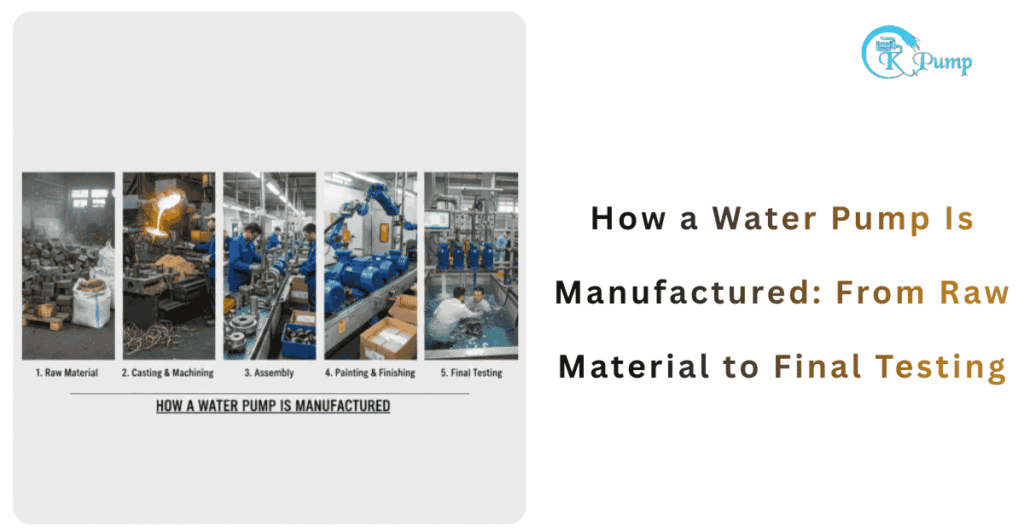
How a Water Pump Is Manufactured

Water pumps are used everywhere—homes, farms, factories, buildings, and cities.
But have you ever thought how a water pump is actually made?

In this guide, I’ll explain the full water pump manufacturing process, starting from raw materials and ending with final quality testing—step by step, in very easy language.

This article also explains:

  • Water pump production process

  • Pump manufacturing steps

  • How industrial water pumps are made

  • Water pump assembly and testing

Lorem ipsum dolor sit amet, consectetur adipiscing elit. Ut elit tellus, luctus nec ullamcorper mattis, pulvinar dapibus leo.

Understanding What a Water Pump Is

A water pump is a machine that moves water from one place to another using mechanical power.
It works by creating pressure so water can flow through pipes.

There are many types:

  • Submersible pumps

  • Centrifugal pumps

  • Open well pumps

  • Self-priming pumps

Even though designs are different, the basic manufacturing steps are almost the same.

Step 1: Selection of Raw Materials

The first step in water pump manufacturing is choosing the right raw materials.

Good quality raw materials decide:

  • Pump life

  • Pump strength

  • Power consumption

  • Performance

Common Raw Materials Used in Water Pumps

  • Cast Iron – for pump body

  • Stainless Steel – for shaft and fasteners

  • Copper Wire – for motor winding

  • Aluminium – for motor housing

  • Plastic or Brass – for impeller (depends on model)

  • Rubber & Seals – to prevent leakage

At CK Pump, raw materials are chosen carefully to ensure durability and power-saving performance.

Step 2: Casting of Pump Body

Now the raw material is shaped into parts.

What Is Casting?

Casting means melting metal and pouring it into a mold to get the required shape.

Process:

  1. Metal is heated in a furnace

  2. Melted metal is poured into a mold

  3. Mold is cooled

  4. Solid pump body is removed

This step creates:

  • Pump casing

  • Motor housing

  • End covers

After casting, parts look rough and are not ready to use yet.

Step 3: Machining and Finishing

In this stage, rough parts are made smooth and accurate.

Machining Includes:

  • Cutting

  • Drilling

  • Grinding

  • Turning

Machines like:

  • Lathe machines

  • CNC machines

  • Drilling machines

are used to make sure:

  • Parts fit perfectly

  • No vibration happens

  • Pump runs smoothly

This step is very important for pump balance and efficiency.

Step 4: Manufacturing the Impeller

The impeller is the heart of the water pump.

What Does an Impeller Do?

It rotates and pushes water with pressure.

Impellers are made from:

  • Brass

  • Stainless steel

  • Engineering plastic

The impeller design affects:

  • Water flow rate

  • Pressure

  • Energy efficiency

Each impeller is checked for:

  • Size accuracy

  • Weight balance

  • Crack-free surface

Step 5: Motor Winding Process

Now the electric motor part is prepared.

Motor Winding Explained Simply

  • Copper wire is wrapped around the motor core

  • This creates a magnetic field

  • When power is supplied, the motor rotates

Good winding means:

  • Less electricity use

  • Less heat

  • Longer motor life

After winding:

  • Insulation varnish is applied

  • Motor is baked for strength

Step 6: Shaft, Bearings, and Seal Fitting

Small parts matter a lot in water pump manufacturing.

Important Components:

  • Shaft – transfers motor power

  • Bearings – reduce friction

  • Mechanical seals – stop water leakage

All parts are:

  • Fitted carefully

  • Aligned properly

  • Checked for smooth movement

Poor fitting here can cause noise, leakage, or early failure.

Step 7: Assembly of the Water Pump

Now all parts are assembled together.

Assembly Includes:

  • Fixing motor with pump body

  • Mounting impeller on shaft

  • Installing seals and bearings

  • Tightening all fasteners

This stage turns separate parts into a working water pump.

Experienced technicians ensure:

  • Proper alignment

  • Correct torque

  • No loose parts

Step 8: Surface Treatment and Painting

To protect the pump from:

  • Rust

  • Dust

  • Moisture

Surface Finishing Process:

  • Cleaning

  • Primer coating

  • Final paint

Industrial-grade paint is used so the pump:

  • Looks professional

  • Lasts longer in harsh conditions

Step 9: Performance and Quality Testing

This is one of the most important steps.

Types of Water Pump Testing

1. Hydraulic Testing

  • Flow rate check

  • Head (height) check

2. Electrical Testing

  • Voltage

  • Current

  • Power consumption

3. Leakage Testing

  • Seal performance

  • Body tightness

4. Noise and Vibration Test

  • Smooth running

  • Silent operation

Only pumps that pass all tests move to the next stage.

Step 10: Final Inspection and Packing

Before packing, the pump is:

  • Visually inspected

  • Cleaned

  • Labeled

Then it is packed with:

  • User manual

  • Warranty card

  • Safety instructions

Strong packaging ensures the pump reaches customers without damage.

Why Manufacturing Quality Matters in Water Pumps

A well-manufactured water pump:

  • Saves electricity

  • Works longer

  • Needs less maintenance

  • Gives stable water flow

That’s why choosing a trusted water pump manufacturer is important.

Why CK Pump Focuses on Quality Manufacturing

At CK Pump, every manufacturing step is done with care:

  • Quality raw materials

  • Skilled technicians

  • Proper testing

  • Energy-efficient design

Tagline: Flowing Quality. Saving Power.

Final Thoughts

Now you know how a water pump is manufactured from raw material to final testing.

Even though it looks simple from outside, a water pump is made through:

  • Careful planning

  • Skilled work

  • Multiple quality checks

A good manufacturing process means a reliable and long-lasting water pump.

Leave a Comment

Your email address will not be published. Required fields are marked *

Scroll to Top