
Winding Quality vs Pump Failure Rate: What Manufacturers Know
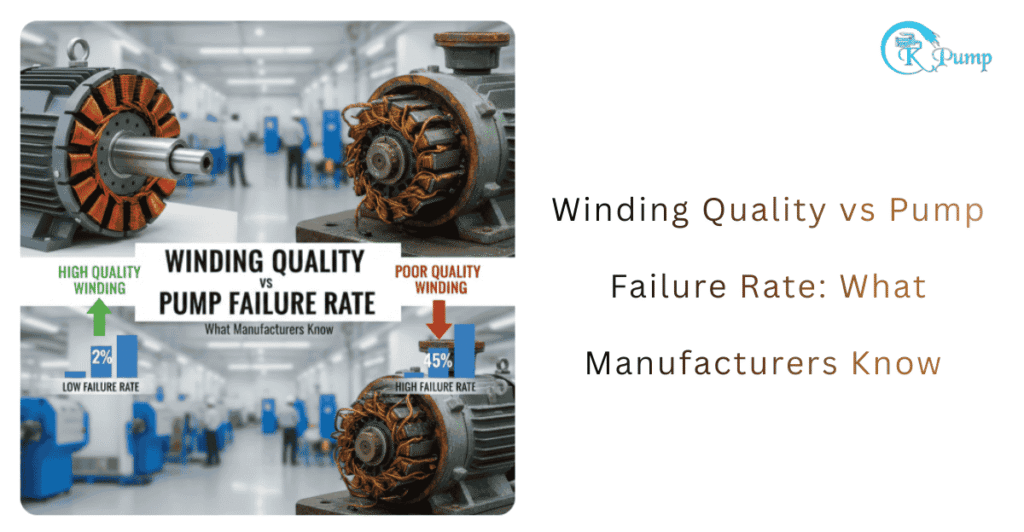
If you are buying a water pump, most sellers will talk about HP, price, and warranty.
Very few will talk about the most important thing inside the motor — winding quality.
But here is the truth:
Bad winding = High pump failure rate
Good winding = Long life + Low repair cost
In this guide, we will explain in very simple words:
What is motor winding?
How winding quality affects pump breakdown
Why pumps fail early
What manufacturers know about copper vs aluminium winding
How to check winding quality before buying
Why premium brands like CK Pump focus heavily on copper winding
This is pure practical knowledge. No marketing talk.
What Is Motor Winding in a Water Pump?
Inside every submersible pump, openwell pump, or self-priming pump, there is a motor.
Inside that motor, there are coils of wire wrapped around a core.
These coils are called motor windings.
When electricity passes through these windings:
A magnetic field is created
The rotor starts rotating
The pump pushes water
If winding quality is poor, heat increases.
If heat increases, insulation melts.
If insulation melts, motor burns.
Simple.
Why Winding Quality Directly Affects Pump Failure Rate
Imagine two pumps:
Pump A → Pure copper winding + proper insulation
Pump B → Low-grade aluminium winding + thin insulation
Both look same from outside.
But inside?
Pump A:
Less heat
Smooth current flow
Lower electricity loss
Longer motor life
Pump B:
More heat
Voltage fluctuation damage
Coil short circuit
Early motor burn
This is called winding durability impact on pump reliability.
Manufacturers already know this.
But cheaper brands cut cost here.
Top Reasons Why Pumps Fail Early (Based on Industry Analysis)
After analyzing common manufacturing and repair patterns, here are real reasons behind high pump breakdown rates:
1. Low Quality Copper or Mixed Metal
Some manufacturers mix copper with scrap material.
Result → Higher resistance → More heat → Faster burnout.
2. Thin Insulation Coating
Insulation protects winding from short circuit.
Low insulation quality causes:
Current leakage
Phase failure
Sudden motor damage
3. Loose Winding Design
Improper coil layering leads to:
Uneven heat distribution
Vibration damage
Early failure
4. Overheating Due to Aluminium Winding
Aluminium winding is cheaper but:
Higher resistance
More heat generation
Higher pump failure ratio
That’s why winding material quality is critical.
Copper vs Aluminium Winding: What Manufacturers Know
Let’s compare clearly.
| Factor | Copper Winding | Aluminium Winding |
|---|---|---|
| Conductivity | Very High | Lower |
| Heat Generation | Low | High |
| Motor Efficiency | Better | Less |
| Pump Lifespan | Longer | Shorter |
| Failure Rate | Low | High |
| Cost | Slightly higher | Cheap |
This is why premium pump manufacturers prefer 100% copper winding.
Companies like CK Pump use copper winding because:
It reduces motor failure probability
It increases energy efficiency
It lowers long-term repair complaints
Cheap pumps reduce price by cutting winding cost.
The Science Behind Winding Failure
Let’s go little deeper, but still simple.
When electricity passes through winding:
Some energy converts into heat
If resistance is high → heat increases
If heat increases beyond limit → insulation melts
If insulation melts → coil short circuit
This leads to:
Motor burning
Pump not starting
Tripping MCB
Low water pressure
This is called thermal stress damage in pump motors.
Good winding reduces electrical resistance and prevents this.
How Winding Quality Controls Pump Reliability
Winding quality impacts:
1. Energy Efficiency
Better winding → Lower power loss → Lower electricity bill.
2. Heat Management
Good copper winding distributes heat evenly.
3. Voltage Fluctuation Resistance
In India, voltage fluctuation is common.
Strong winding handles voltage spikes better.
4. Moisture Protection
High-grade varnish coating prevents moisture-based short circuit.
5. Mechanical Stability
Tight and balanced coil winding prevents vibration damage.
So yes — winding quality directly controls pump durability.
Why Dealers Rarely Talk About This
Because:
Customers compare only price.
Copper winding increases manufacturing cost.
Many buyers don’t know technical differences.
So sellers say:
“Sab same hai. Warranty hai na?”
But warranty doesn’t stop inconvenience.
If pump fails:
Water supply stops
Farming affected
Labour cost increases
Repair cost added
So low price today = high maintenance tomorrow.
Signs of Poor Winding Quality in a Pump
Here are warning signs:
Pump heats up quickly
Burning smell
Repeated tripping
Low water pressure
Motor noise increases
Frequent repair needed
If these happen within 1–2 years, winding quality is probably weak.
How to Check Winding Quality Before Buying
You cannot open motor in shop.
But you can ask smart questions:
Ask These:
Is it 100% copper winding?
What grade insulation used?
What is temperature rating?
Is it tested under load conditions?
What is failure rate data?
If seller avoids answering → Be careful.
Manufacturing Standards That Reduce Pump Failure Rate
Serious manufacturers focus on:
Pure copper winding
Double varnish insulation
Vacuum pressure impregnation (VPI)
Proper coil layering
Thermal overload protection
IS standard testing
These reduce:
Motor burnout cases
Short circuit risk
Overheating failures
Companies like CK Pump focus on:
Copper winding
Power-saving design
Long operational life
Because their goal is low complaint ratio, not just sales volume.
Real-Life Example
Case Study:
Two farmers buy pumps:
Farmer A buys cheaper aluminium winding pump.
Farmer B buys copper winding pump.
After 18 months:
Farmer A → Motor burnt once, repair cost ₹2500
Farmer B → No issue
After 3 years:
Farmer A → Replaced motor
Farmer B → Still running
Total cost of ownership is lower with high-quality winding.
Winding Quality and Power Saving
Low-quality winding wastes electricity.
High resistance = energy loss.
Copper winding:
Improves motor efficiency
Reduces current draw
Saves electricity
This is why power-saving pump models use better winding material.
So winding quality affects both:
Pump lifespan
Electricity bill
Technical Terms Related to Winding & Failure Rate
Here are related concepts manufacturers understand:
Motor coil integrity
Electrical resistance stability
Thermal endurance
Insulation class rating
Current carrying capacity
Electromagnetic efficiency
Pump motor reliability factor
Burnout probability
Breakdown frequency
Operational durability
All these connect directly to winding design quality.
Why Cheap Pumps Have High Failure Rate
Simple answer:
Cost cutting.
Where do they cut cost?
Copper purity
Insulation thickness
Coil layering
Quality testing
Result?
Higher pump breakdown frequency.
How Winding Quality Impacts Submersible Pumps More
Submersible pumps work inside water.
They face:
Heat
Moisture
Pressure
Continuous load
If winding insulation is weak:
Moisture enters
Short circuit happens
Pump fails early
So submersible pumps need even stronger winding quality.
Manufacturer’s Perspective: What They Actually Track
Professional pump manufacturers track:
Failure rate percentage
Burnout cases per 1000 units
Heat tolerance performance
Warranty claims
Field feedback
They know that winding quality is biggest factor in reducing:
Customer complaints
Service cost
Brand damage
That’s why serious brands invest in better copper winding and insulation.
Final Truth: Winding Quality = Pump Life
If you remember only one line from this article:
Better winding means lower pump failure rate.
It controls:
Motor burnout risk
Heat resistance
Voltage stability
Energy efficiency
Overall durability
When buying pump, don’t just see HP and price.
Ask about winding material, insulation quality, and testing standards.
Brands that focus on internal motor strength, like CK Pump, understand that long-term reliability matters more than short-term price advantage.
Conclusion
The connection between winding quality and pump failure rate is direct and powerful.
Low-quality winding leads to:
Short circuits
Motor damage
Frequent breakdown
High-quality copper winding leads to:
Long life
Stable performance
Lower maintenance
Better efficiency
So next time someone says:
“Sab pump same hai.”
You will know —
They are not.
Inside the motor, everything changes.
And that is what manufacturers truly know.