GET INSTANT ONLINE QUOTATION ON WHATSAPP :  

+91 79848 29257

Overheating Issues in Water Pumps

Overheating Issues in Water Pumps: Causes, Warning Signs, and Permanent Solutions

Overheating Issues in Water Pumps Causes, Warning Signs, and Permanent Solutions

Water pump overheating is not a small technical problem. It is usually the first signal of internal stress inside the motor, bearings, impeller, or electrical system. Ignoring it reduces pump life, increases electricity consumption, and often ends with a sudden motor burn.

Whether you are using a submersible pump, self-priming pump, booster pump, or industrial water pump, overheating follows similar mechanical and electrical patterns. The good news? Most overheating problems are preventable if you understand the root causes early.

Let’s break it down in a simple, practical way.
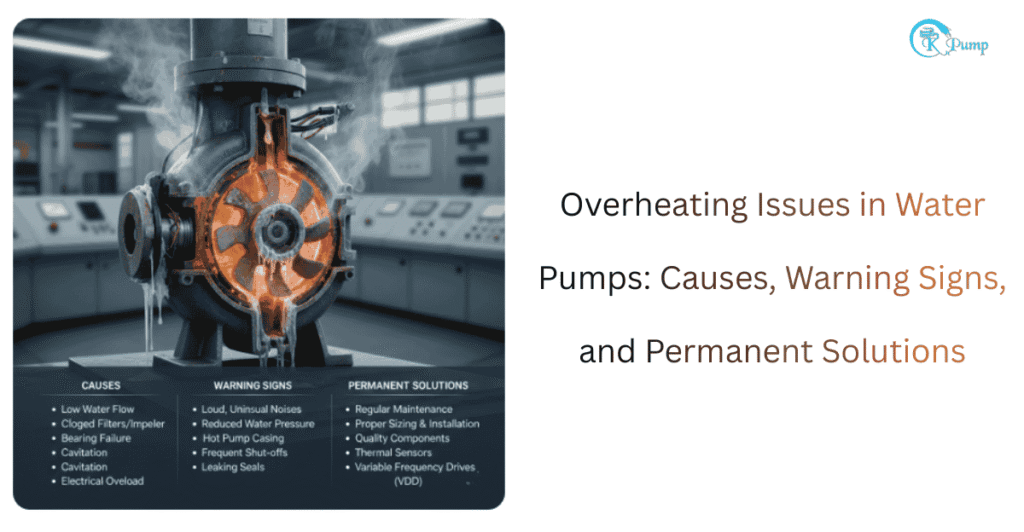
What Does Overheating in Water Pumps Mean?

Overheating happens when the motor temperature rises beyond its designed operating limit. Every pump motor is built to handle a specific heat range. When cooling airflow, water lubrication, or electrical balance gets disturbed, heat builds up faster than it can escape.

This leads to:

  • Insulation damage

  • Bearing failure

  • Rotor deformation

  • Reduced motor efficiency

  • Sudden shutdown by thermal protection

In short — your pump starts working harder but delivering less.

Common Causes of Water Pump Overheating

Understanding the cause is more important than treating the symptom.

1. Dry Running (No Water Flow)

Dry running is the number one reason for pump overheating.

When water does not flow through the pump:

  • Internal friction increases

  • Mechanical seals lose cooling

  • Motor load rises sharply

This usually happens due to:

  • Low water level

  • Air lock

  • Blocked suction pipe

  • Foot valve leakage

Even 10–15 minutes of dry running can permanently damage the pump.

2. Blocked Impeller or Clogged Pipes

Dirt, sand, rust particles, or debris can restrict water movement.

When flow becomes restricted:

  • Motor draws extra current

  • RPM reduces

  • Heat generation increases

This is common in borewell pumps and agricultural installations where filtration is poor.

3. Voltage Fluctuation and Power Supply Issues

Low voltage is a silent killer.

When voltage drops:

  • Motor compensates by drawing higher current

  • Windings heat up rapidly

  • Efficiency drops

High voltage can also damage insulation layers and increase heat stress.

Stable power supply is essential for long pump life.

4. Overloading the Pump Beyond Capacity

Using a pump outside its designed duty point causes overheating.

Examples:

  • Using a domestic pump for industrial usage

  • Pumping thicker fluids than recommended

  • Excessive head pressure

Every pump has a rated flow and head range. Crossing it creates continuous thermal stress.

5. Poor Ventilation and Cooling

For surface pumps and self-priming models:

  • Blocked ventilation slots

  • Dust accumulation

  • Enclosed installation spaces

can trap heat around the motor body.

Proper airflow is required to remove excess heat.

6. Bearing Failure or Mechanical Friction

Worn bearings increase shaft resistance.

Signs include:

  • Grinding noise

  • Vibration

  • Higher operating temperature

Friction means the motor works harder to rotate the impeller, producing unnecessary heat.

Early Warning Signs of Pump Overheating

Most pump failures give warning signals before complete breakdown.

Watch out for:

  • Pump body becoming unusually hot

  • Automatic thermal cut-off triggering repeatedly

  • Reduced water pressure

  • Burning smell from motor

  • Strange noise or vibration

  • Frequent tripping

Ignoring these signs turns small maintenance issues into costly motor rewinding jobs.

How Overheating Affects Pump Performance

Overheating does more than just raise temperature.

Efficiency Loss

Hot motors consume more electricity while delivering less water output.

Reduced Motor Life

Insulation degrades faster under heat. This shortens winding lifespan.

Seal Damage

Mechanical seals rely on water cooling. Heat causes leakage and shaft wear.

Sudden Breakdown Risk

Overheated motors often fail without warning once internal insulation collapses.

Practical Solutions to Prevent Water Pump Overheating

Now let’s talk about real-world solutions, not just theory.

Ensure Continuous Water Flow

  • Maintain proper suction depth

  • Use foot valves with good sealing

  • Avoid air leakage in pipelines

  • Check borewell water level regularly

Never allow dry running.

Install Voltage Protection Devices

Using:

  • Voltage stabilizers

  • Phase preventers (for three-phase pumps)

  • Surge protectors

helps protect motors from electrical overheating.

Clean Impeller and Filters Periodically

Schedule maintenance:

  • Remove debris from strainer

  • Flush pipelines

  • Clean impeller chamber

This improves flow and reduces load.

Match Pump Capacity With Application

Always choose pumps based on:

  • Required flow rate

  • Total head pressure

  • Water source depth

  • Usage duration

Oversizing or undersizing both cause overheating.

Improve Ventilation Around Surface Pumps

  • Leave airflow gap around motor

  • Avoid closed cabinets

  • Keep motor fins clean

Air cooling is critical for surface pump models.

Lubricate and Replace Bearings on Time

Prevent friction-related heating by:

  • Using recommended lubricants

  • Replacing worn bearings early

  • Aligning motor shaft properly

Why Quality Manufacturing Matters (CK Pump Advantage)

At CK Pump, overheating protection starts at the manufacturing stage.

Our pumps are designed with:

  • High-grade copper windings

  • Thermal overload protection

  • Optimized impeller balancing

  • Energy-efficient motor design

  • Better heat dissipation structure

This ensures stable performance even in continuous operation environments.

Cheap pumps often skip these engineering details, which is why overheating complaints are common.

When Should You Replace Instead of Repair?

Sometimes repairing an overheated pump is not economical.

Consider replacement if:

  • Motor winding has burned multiple times

  • Shaft alignment is permanently damaged

  • Seal chamber is corroded

  • Power consumption has increased significantly

A new energy-efficient pump can save electricity costs in the long run.

Frequently Asked Questions (FAQ)

Can overheating damage submersible pumps?

Yes. Submersible pumps rely on surrounding water for cooling. Low water levels reduce cooling efficiency and cause motor overheating.

How hot is too hot for a water pump motor?

Most pump motors should not exceed 80–90°C casing temperature. If you cannot touch the motor body for more than 2 seconds, it is overheating.

Does continuous running cause overheating?

Continuous running is safe only if the pump is designed for duty cycle operation and water flow is stable. Otherwise, heat accumulation occurs.

Can improper installation cause overheating?

Absolutely. Wrong pipe sizing, air leakage, uneven foundation, and misalignment increase load on the motor.

Final Thoughts

Overheating issues in water pumps are not random failures. They are engineering signals telling you something is wrong with flow, power, load, or cooling.

Fix the cause — not just the symptom.

Regular maintenance, correct pump selection, stable power supply, and quality manufacturing make the biggest difference.

If you want long-lasting performance with low maintenance headaches, choosing the right pump brand matters as much as proper installation.

Leave a Comment

Your email address will not be published. Required fields are marked *

Scroll to Top