
Motor Winding Grades: What Makes a Pump Run 10+ Years
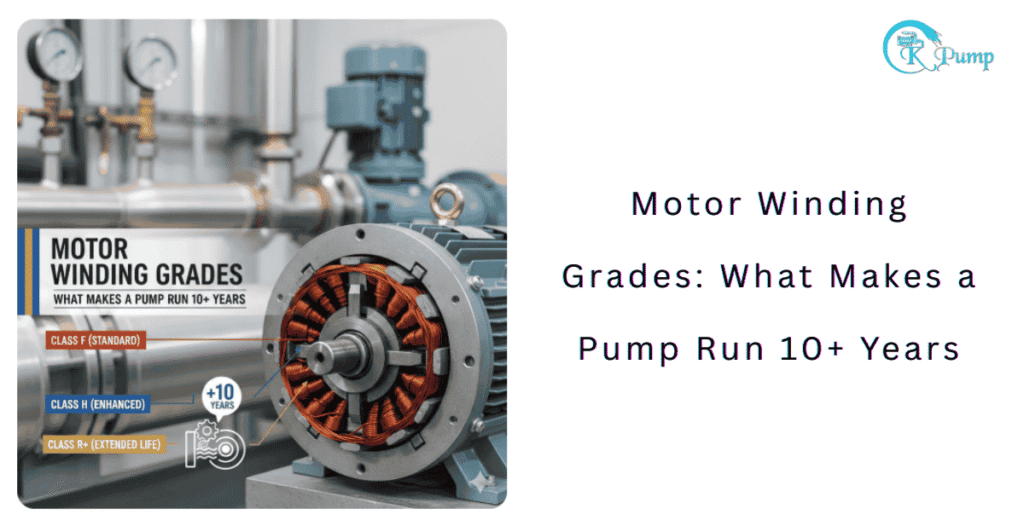
When a water pump fails early, most people blame voltage, water quality, or usage. In reality, the real story often starts inside the motor—specifically with motor winding grades and winding quality.
As a water pump manufacture, we see this every day. Two pumps may look identical from the outside, but one runs smoothly for 10–12 years while the other struggles after 3–4. The difference is rarely luck. It’s engineering choices—especially the grade of copper winding, insulation class, and how carefully the winding is executed.
This article explains, in simple terms, what motor winding grades really mean, why they matter, and how they directly affect pump life, efficiency, and maintenance costs.
m dolor sit amet, consectetur adipiscing elit. Ut elit tellus, luctus nec ullamcorper mattis, pulvinar dapibus leo.
What Is Motor Winding in a Water Pump?
Motor winding is the heart of an electric water pump. It’s the copper wire wound around the stator that creates a magnetic field when electricity flows. That magnetic field is what turns electrical power into mechanical rotation.
If the winding:
Uses poor copper
Has uneven turns
Uses low-grade insulation
Is overheated during manufacturing
…the pump may still run, but it will never run reliably for the long term.
This is why experienced water pump manufacturers never treat winding as a cost-cutting area.
Understanding Motor Winding Grades (Simple Explanation)
Motor winding grades are defined by three core factors:
1. Copper Purity (Electrolytic Grade Copper)
High-quality pumps use 99.9% pure electrolytic copper. Lower grades may include recycled or mixed copper, which increases resistance.
Why this matters:
Higher resistance = more heat
More heat = insulation damage
Insulation damage = winding failure
A pump that heats excessively will face common water pump problems like tripping, low efficiency, or complete burnout.
2. Insulation Class (Class B, F, or H)
The insulation around the copper wire decides how much heat the winding can tolerate.
| Insulation Class | Max Temperature | Typical Lifespan Impact |
|---|---|---|
| Class B | 130°C | Basic applications |
| Class F | 155°C | Long-duty cycles |
| Class H | 180°C | Heavy & industrial use |
For pumps expected to run for 10+ years, Class F insulation is usually the minimum benchmark.
A good water pump manufacture always matches insulation grade with real-world operating conditions, not brochure claims.
3. Winding Technique & Slot Fill
Even the best copper fails if winding is done poorly.
Proper winding means:
Uniform turns
Correct slot fill ratio
No air gaps
Tight binding to avoid vibration
Poor winding technique leads to:
Hot spots
Noise
Uneven magnetic field
Early motor failure
This is where winding quality separates long-life pumps from short-term products.
Why Motor Winding Grades Directly Affect Pump Lifespan
A pump doesn’t usually fail suddenly. It degrades slowly.
Here’s the real-life chain reaction:
Low-grade winding → Higher resistance → Excess heat → Insulation breakdown → Short circuit → Motor failure
High-grade winding breaks this cycle by:
Running cooler
Maintaining magnetic efficiency
Reducing current draw
Protecting insulation over years
This is why pumps with superior winding often need less water pump maintenance over their lifetime.
Motor Winding vs Common Water Pump Problems
Many issues users face are symptoms, not root causes.
Problem: Pump trips frequently
Root cause: Overheating due to poor winding grade
Problem: Low water discharge
Root cause: Reduced magnetic torque from uneven winding
Problem: High electricity bill
Root cause: Increased current draw from inferior copper
Problem: Motor burns during voltage fluctuation
Root cause: Low insulation tolerance
Understanding this helps users choose pumps based on engineering, not just price.
How Good Winding Reduces Water Pump Maintenance
A pump with superior winding quality:
Runs cooler
Handles voltage fluctuations better
Resists insulation aging
Maintains efficiency longer
This means:
Fewer service calls
Lower rewinding costs
Longer replacement cycles
In practical terms, good winding can save more money than the initial pump cost difference.
That’s why professional buyers—builders, industries, and farmers—ask about winding grade first.
What Reputable Water Pump Manufacturers Do Differently
A responsible water pump manufacture does not:
Use undersized copper wire
Mix insulation grades
Rush winding to increase output
Instead, they focus on:
Controlled winding tension
Heat-tested insulation
Load testing under real conditions
Long-duration motor trials
These steps don’t show on the product label—but they decide whether a pump lasts 3 years or 13 years.
How to Identify a Pump with Good Motor Winding
While users can’t see inside the motor, there are signs:
Lower operating noise
Cooler motor body after long use
Stable performance under voltage variation
Longer warranty confidence from manufacturer
If a brand openly talks about winding quality, copper grade, and insulation class, it’s usually a good sign.
Final Thoughts: Motor Winding Is Not a Small Detail
Motor winding grades are not technical jargon—they are the foundation of pump durability.
If your goal is:
Long service life
Low maintenance
Stable performance
Lower power consumption
…then motor winding quality should be your first evaluation point, not the last.
For any water pump expected to run reliably for 10+ years, high-grade copper, proper insulation, and precision winding are non-negotiable.
In the end, a pump doesn’t fail because it worked too long—it fails because its winding wasn’t built to last.