GET INSTANT ONLINE QUOTATION ON WHATSAPP :  

+91 79848 29257

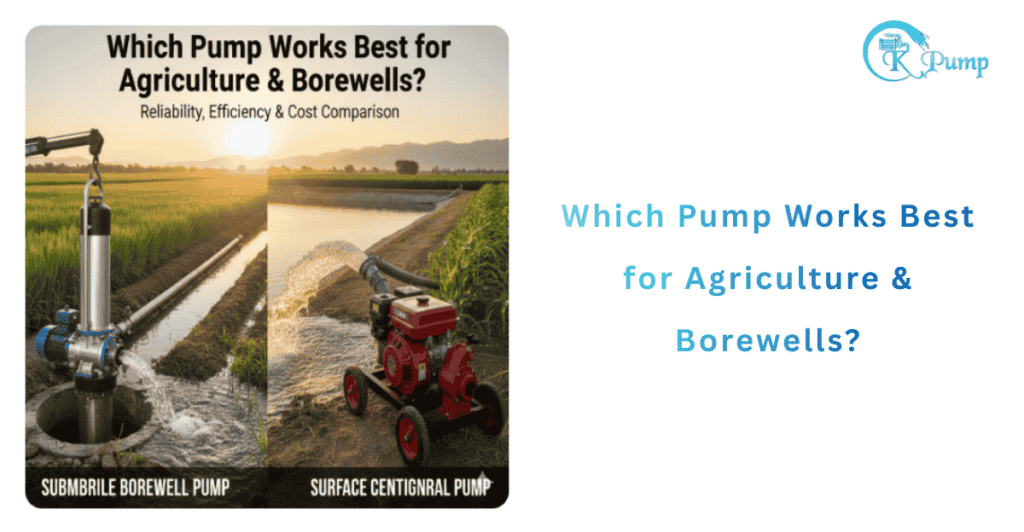
Which Pump Works Best for Agriculture & Borewells?

Which Pump Works Best for Agriculture & Borewells?

Which Pump Works Best for Agriculture & Borewells

Choosing the right pump for agriculture or borewells is not as simple as picking the most powerful motor or the cheapest option. Many pump failures, low water output, and high electricity bills happen because the pump type doesn’t match the water source, depth, soil conditions, or usage pattern.

If you are planning irrigation for farms, orchards, or borewell-based water supply, this guide will help you clearly understand which pump works best for agriculture & borewells, and why.

Why Pump Selection Matters in Agriculture

Agriculture pumps work under tougher conditions than domestic pumps. They often run for long hours, deal with fluctuating voltage, and handle water mixed with sand or minerals.

A wrong pump choice can lead to:

  • Low discharge even with high power consumption

  • Motor overheating

  • Frequent breakdowns

  • Short pump lifespan

  • Increased maintenance cost

That’s why understanding pump types and borewell conditions is more important than just buying a higher HP pump.

Understanding Borewell Conditions First

Before deciding on a pump, you must understand your borewell characteristics.

1. Borewell Depth

  • Up to 25–30 feet → Shallow water

  • 30–200 feet → Medium depth

  • 200+ feet → Deep borewell

2. Water Yield

  • Low-yield borewells need pumps that work efficiently at low flow.

  • High-yield borewells require pumps with stable discharge.

3. Water Quality

  • Sandy or mineral-rich water needs robust pump materials.

  • Poor water quality can damage low-grade impellers and seals.

These factors directly decide which pump type will perform best.

Best Pump Types for Agriculture & Borewells

Let’s break this down clearly.

1. Submersible Pumps – Best for Deep Borewells

If your borewell is deep, a submersible pump is usually the best choice.

Why Submersible Pumps Work Best

  • Installed inside the borewell, below water level

  • No suction problem

  • High efficiency for deep water lifting

  • Suitable for continuous agricultural use

Best Use Cases

  • Deep borewells (100 feet to 1000+ feet)

  • Large farms and irrigation systems

  • Areas with fluctuating water tables

Things to Check Before Buying

  • Borewell diameter (4″, 6″, 8″)

  • Required head and discharge

  • Power availability (single-phase or three-phase)

A well-designed submersible pump can run for years with minimal issues, especially when sourced from a best water pump manufacturer that focuses on winding quality, impeller balance, and motor cooling.

2. Openwell Submersible Pumps – Ideal for Farms & Canals

Openwell submersible pumps are often used in agriculture where water is available in:

  • Open wells

  • Canals

  • Tanks

  • Ponds

Key Advantages

  • Can be installed horizontally or vertically

  • High discharge at moderate head

  • Easy installation and maintenance

Best For

  • Flood irrigation

  • Sugarcane, wheat, and paddy fields

  • Areas where water level fluctuates but remains accessible

These pumps are popular in agriculture because they balance flow rate and energy consumption well.

3. Jet Pumps – For Shallow Borewells

Jet pumps are suitable when the water level is not very deep.

When Jet Pumps Make Sense

  • Borewell depth up to 25–30 feet

  • Small farms or gardens

  • Limited power supply

Limitations

  • Lower efficiency compared to submersible pumps

  • Performance drops if water level goes deeper

Jet pumps are not recommended for deep borewells, even if they seem cheaper initially.

4. Self-Priming Pumps – For Surface Water Use

Self-priming pumps are commonly used where water is drawn from:

  • Rivers

  • Canals

  • Storage tanks

Best Uses

  • Temporary irrigation

  • Drip systems

  • Sprinkler irrigation

They are not ideal for deep borewells but work well for surface-level agricultural needs.

Matching Pump Capacity with Crop Type

Different crops need different water flow patterns.

Crop TypeRecommended Pump Focus
PaddyHigh discharge
SugarcaneContinuous duty pumps
CottonBalanced flow & pressure
VegetablesControlled pressure for drip
OrchardsEnergy-efficient steady flow

A good pump selection always considers crop water requirement, not just borewell depth.

Common Mistakes Farmers Make While Choosing Pumps

Many issues come from these common mistakes:

  • Buying higher HP instead of correct head-flow match

  • Ignoring borewell yield capacity

  • Choosing cheap pumps with low-quality winding

  • Not considering voltage fluctuation

  • Skipping professional pump calculation

These mistakes often lead to higher electricity bills and repeated motor rewinding.

How Pump Design Impacts Performance

Two pumps with the same HP can perform very differently.

Key design factors include:

This is where choosing a best water pump manufacturer matters more than just price or brand name.

Manufacturers who design pumps specifically for Indian agricultural conditions tend to deliver better long-term performance.

Energy Efficiency: A Long-Term Cost Factor

In agriculture, pumps often run for hours every day. Even a small efficiency difference can result in large electricity savings over time.

Look for:

  • Lower power consumption at rated discharge

  • Stable output under voltage fluctuation

  • Thermal protection for motors

Energy-efficient pumps reduce operational costs and extend motor life.

Which Pump Works Best Overall?

There is no single “best pump” for everyone.

But in most agricultural and borewell scenarios:

  • Deep borewell → Submersible pump

  • Open wells & canals → Openwell submersible pump

  • Shallow borewell → Jet pump

  • Surface irrigation → Self-priming pump

The best pump is the one that matches:

  • Borewell depth

  • Water yield

  • Crop requirement

  • Power availability

Final Thoughts

Choosing the right pump for agriculture & borewells is a technical decision, not a guess. A properly selected pump can run efficiently for years, while a wrong one can fail within months.

Always focus on:

  • Application suitability

  • Pump design quality

  • Manufacturer credibility

  • Long-term efficiency, not just initial cost

When pumps are engineered by a best water pump manufacturer with real-world agricultural use in mind, the difference shows in performance, durability, and energy savings.

Leave a Comment

Your email address will not be published. Required fields are marked *

Scroll to Top