GET INSTANT ONLINE QUOTATION ON WHATSAPP :  

+91 79848 29257

Shaft, Impeller & Seal Materials: Why They Matter in Water Pump

Shaft, Impeller & Seal Materials: Why They Matter in Water Pump - Ck Pump

Shaft, Impeller & Seal Materials Why They Matter in Water Pump

When people buy a water pump, they mostly ask two things:

Kitna HP hai? Kitna water utha lega?

But very few people ask the most important question:

👉 Pump ke andar ka material kya hai?

Inside every water pump, three parts decide how long it will run and how well it will perform:

  • Shaft

  • Impeller

  • Seal

If these three are made from the right materials, your pump works smoothly for years.
If not, you will face rust, leakage, noise, vibration, and frequent repairs.

In this guide, we will clearly explain:

  • What shaft, impeller and seal do

  • Which materials are used

  • Why material quality matters

  • Which material is best for different applications

  • How to choose the right pump for your need

This guide is written in very easy language. Even a 5th class student can understand it.
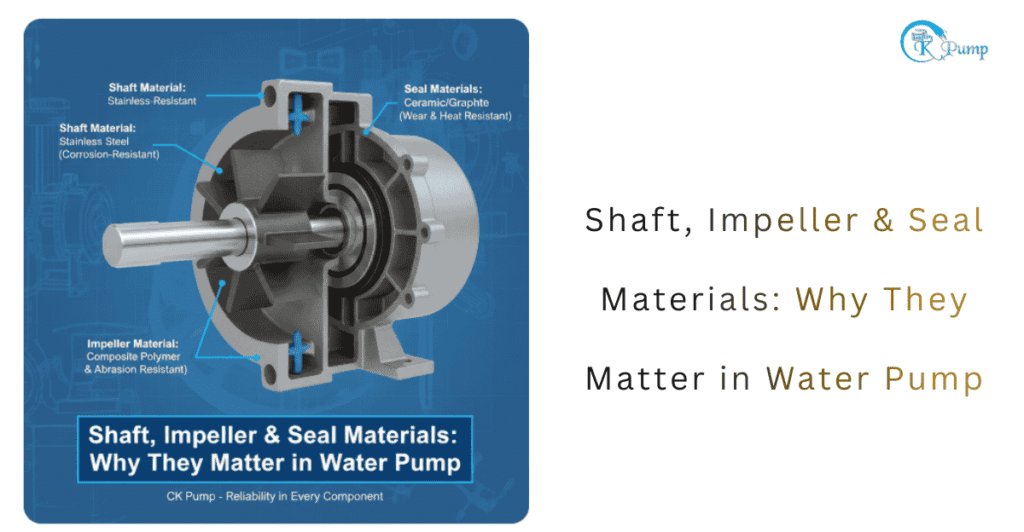
What Is a Pump Shaft? Why Its Material Matters

What is Shaft?

The shaft is a long metal rod inside the pump.
It connects the motor to the impeller.

When the motor rotates, the shaft rotates.
When the shaft rotates, the impeller moves.
When the impeller moves, water flows.

So simple.

If the shaft is weak → whole pump fails.

Common Shaft Materials Used in Water Pumps

1. Stainless Steel Shaft

Most common and best option.

Types often used:

  • SS 410

  • SS 304

  • SS 316

Why stainless steel is good:

  • Rust resistant

  • Strong

  • Long life

  • Good for clean water

Best for:

  • Domestic pumps

  • Borewell pumps

  • Submersible pumps

  • Agricultural pumps

2. Carbon Steel Shaft

  • Cheap material

  • Not rust resistant

  • Short life

Used in:

  • Low-cost pumps

  • Temporary installations

Not recommended for long-term use.

3. Alloy Steel Shaft

  • Extra strong

  • Used in heavy-duty pumps

  • Industrial use

Why Shaft Material Is Important?

If shaft quality is poor:

  • Shaft bends

  • Pump vibrates

  • Bearing damage

  • Seal leakage

  • Impeller misalignment

This reduces pump efficiency and life.

So always check shaft material before buying.

What Is an Impeller? Why Its Material Matters

What is Impeller?

The impeller is the rotating part that pushes water.

When it spins:

  • Water enters from center

  • Water gets pushed outward

  • Pressure increases

  • Water flows to outlet

Impeller is the heart of centrifugal pumps.

If impeller material is wrong, pump performance drops.

Common Impeller Materials in Water Pumps

1. Cast Iron Impeller

Very common.

Advantages:

  • Strong

  • Affordable

  • Good for normal water

Disadvantages:

  • Can rust

  • Heavy

Used in:

  • Agriculture pumps

  • Surface pumps

2. Brass Impeller

Better than cast iron.

Advantages:

  • Rust resistant

  • Good strength

  • Longer life

Used in:

  • Domestic pumps

  • Clean water supply

3. Stainless Steel Impeller

High quality option.

Advantages:

  • Excellent corrosion resistance

  • Long life

  • Smooth performance

Best for:

  • Borewell pumps

  • Chemical water

  • Hard water

4. Bronze Impeller

  • Premium quality

  • Marine applications

  • Salt water resistant

5. Engineering Plastic (Noryl) Impeller

Modern pumps use this.

Advantages:

  • Lightweight

  • Rust free

  • Energy efficient

Best for:

  • Domestic booster pumps

  • RO systems

  • Clean water use

Why Impeller Material Is Important?

If impeller corrodes:

  • Efficiency reduces

  • Water pressure drops

  • Noise increases

  • Energy consumption increases

Bad material = frequent replacement.

Good material = long life + energy saving.

What Is a Pump Seal? Why Seal Material Matters

What is Seal?

Seal prevents water from leaking where the shaft passes through pump body.

Without seal:
Water will leak out continuously.

There are two main types:

  • Mechanical seal

  • Gland packing

Most modern pumps use mechanical seals.

Parts of Mechanical Seal

Mechanical seal has two main faces:

  • Rotary face

  • Stationary face

Material of these faces is very important.

Common Seal Materials

1. Carbon + Ceramic Seal

Most common combination.

Advantages:

  • Affordable

  • Good for clean water

  • Smooth operation

Used in:

  • Domestic pumps

  • Borewell pumps

2. Silicon Carbide Seal

High performance material.

Advantages:

  • Very hard

  • Wear resistant

  • Long life

Best for:

  • Industrial pumps

  • Dirty water

  • Slurry

3. Tungsten Carbide Seal

Heavy duty.

  • Very strong

  • Used in abrasive liquids

4. Viton / Nitrile Rubber O-rings

Used in seal rubber parts.

Viton:

  • Chemical resistant

  • High temperature resistant

Nitrile:

  • Normal water use

Why Seal Material Matters?

If seal material is poor:

  • Water leakage

  • Motor damage

  • Short circuit

  • Frequent repair

Seal failure is one of the biggest reasons pumps stop working.

How Shaft, Impeller & Seal Work Together

Let’s understand simply:

Motor → Shaft → Impeller → Water Flow
Seal → Prevents Leakage

If one part fails:
Entire pump performance drops.

For example:

  • Good impeller + weak shaft → vibration

  • Strong shaft + poor seal → leakage

  • Good seal + weak impeller → low pressure

So pump material selection must be balanced.

Material Selection Based on Water Type

Different water needs different material.

Clean Water (Home Use)

Best combination:

  • Stainless steel shaft

  • Brass or plastic impeller

  • Carbon-ceramic seal

Hard Water

Hard water causes scaling.

Better choice:

  • SS shaft

  • Stainless steel impeller

  • Good quality mechanical seal

Borewell Water

Often contains sand.

Best:

  • SS shaft

  • Stainless steel or brass impeller

  • Silicon carbide seal

Chemical or Industrial Water

Needs high corrosion resistance.

Best:

  • SS 316 shaft

  • SS impeller

  • Viton seal

Agricultural Use

  • Cast iron body

  • SS shaft

  • Brass or cast iron impeller

How Material Impacts Pump Efficiency

Better materials mean:

  • Less friction

  • Less corrosion

  • Smooth rotation

  • Better hydraulic performance

  • Lower energy consumption

Poor material means:

  • Rough surface

  • More resistance

  • Higher electricity bill

Material quality directly affects pump efficiency and durability.

Signs Your Pump Material Is Low Quality

If you see:

  • Rust flakes

  • Brown water

  • Continuous leakage

  • Loud noise

  • Shaft vibration

  • Impeller damage

Then internal components may be low-grade.

Why Trusted Manufacturers Focus on Material Quality

Good pump manufacturers always mention:

  • Shaft material

  • Impeller material

  • Seal type

Because they know material decides durability.

When you choose a reliable manufacturer like CK Pumps, you should always check:

  • Is shaft stainless steel?

  • Is impeller corrosion resistant?

  • What seal is used?

Material transparency means quality confidence.

Frequently Asked Questions (FAQ)

Q1: Which shaft material is best for water pump?

Stainless steel (SS 304 / SS 410) is best for most applications.

Q2: Which impeller is better – brass or plastic?

For domestic clean water → both are good.
For long life → brass is stronger.

Q3: Why does mechanical seal fail?

Reasons:

  • Dry running

  • Poor material

  • Misalignment

  • Sand in water

Q4: Does material affect pump price?

Yes.
Better material = slightly higher cost
But long life = lower maintenance

Final Conclusion: Why Shaft, Impeller & Seal Materials Matter

When buying a pump, don’t just check:

  • HP

  • Price

  • Brand

Always check:

  • Shaft material

  • Impeller material

  • Seal material

These internal pump components decide:

  • Pump durability

  • Performance

  • Energy efficiency

  • Maintenance cost

  • Leakage protection

A pump is not just a machine.
It is a system where material selection decides success.

If materials are strong, corrosion-resistant and properly designed, your pump will run smoothly for years without trouble.

Leave a Comment

Your email address will not be published. Required fields are marked *

Scroll to Top