
Difference Between Self Priming and Submersible Water Pumps - Ck Pump
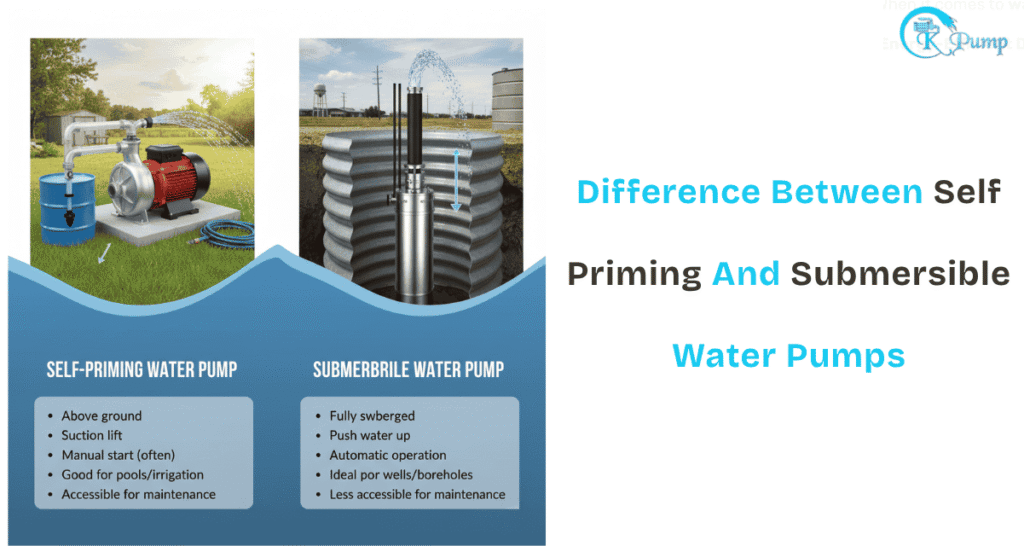
When choosing the right water pump for your home, farm, or industry, one question often comes up — should you go for a self-priming pump or a submersible pump?
Both serve the same purpose — to move water efficiently — but they work in different ways, are used for different applications, and have unique advantages.
This guide explains the difference between self-priming and submersible water pumps, how each works, and which one might be the better fit for your requirement.
What Is a Self-Priming Water Pump?
A self-priming pump is designed to draw water automatically without manually filling the suction pipe or casing every time.
These pumps are installed above the water source (such as a tank, well, or sump) and can lift water from below ground level up to a certain height.
How It Works
Self-priming pumps work by creating a vacuum inside the pump chamber. When started, the pump removes air from the suction pipe and draws water up until it starts flowing continuously.
They are ideal for places where the water source is not submerged, like small gardens, houses, and commercial setups.
Key Features
Installed Above The Water Level
Capable Of Priming Automatically
Easy To Maintain And Clena
Suitable For Shallow Water Source (Up To 8 Mtrs Typically)
What Is a Submersible Water Pump?
A submersible water pump, as the name suggests, is completely submerged in water.
The pump and motor are sealed together in a waterproof casing and placed inside the water source — usually a borewell, sump, or underground tank.
How It Works
Since the pump is already under water, it does not require priming. The motor pushes water upward directly through the delivery pipe using pressure.
Submersible pumps are known for their efficiency, low noise, and ability to lift water from deep sources.
Key Features
Installed Inside The Water Source
No Need For Priming
More Energy-Efficient Than Surface Pumps
Ideal For Deep Wells, Bireholes, And Large Water Storage Tanks
Major Difference Between Self Priming and Submersible Water Pumps
| Feature | Self Priming Pump | Submersible Pump |
|---|---|---|
| Installation | Above the water source | Fully submerged in water |
| Priming Requirement | Requires initial priming; later self-primes | No priming needed |
| Water Source Depth | Suitable for shallow water (up to 8m) | Suitable for deep water sources (up to 250m or more) |
| Efficiency | Slightly less efficient due to air handling | More efficient, less power loss |
| Noise Level | Louder during operation | Very quiet |
| Cooling Method | Air-cooled motor | Water-cooled motor |
| Maintenance | Easier to access and service | Requires removal from water for maintenance |
| Applications | Home water supply, garden, irrigation, small industries | Borewell, agriculture, municipal water supply, drainage, sewage systems |
Which Pump Is Better for You?
Choosing between a self-priming and submersible pump depends on your water source depth, usage, and installation location.
Choose a Self-Priming Pump If:
Your water source is shallow (tank, open well, or small sump)
You need a pump for household or garden use
You prefer easy maintenance and above-ground setup
You need moderate water pressure and flow
Choose a Submersible Pump If:
Your water source is deep (borewell, deep sump, or underground tank)
You need high discharge capacity
You want quiet operation and better efficiency
You require continuous water supply for farms, housing societies, or industries
Advantages of Self Priming Pumps
Quick start and restart even after air enters the system
Compact and easy to install above ground
Cost-effective and low maintenance
Ideal for domestic water transfer and small irrigation
Advantages of Submersible Pumps
No suction limitations — can lift water from great depths
Energy-efficient due to direct water contact and pressure lift
Low noise operation
Durable, corrosion-resistant construction
CK Pump – Flowing Quality, Saving Power
At CK Pump, we manufacture both self-priming and submersible water pumps engineered for Indian water conditions.
Our pumps are known for high efficiency, long life, and low power consumption, making them a reliable choice for domestic, agricultural, and industrial applications.
Whether you need a self-priming pump for your home or a submersible pump for your borewell, CK Pump has the right solution to fit your needs.
Explore our range of Self Priming and Submersible Water Pumps today and find the perfect model for your water system.
Final Thoughts
The difference between self-priming and submersible water pumps mainly lies in how they operate and where they are installed.
A self-priming pump is best for surface-level water sources, while a submersible pump is ideal for deep and continuous water lifting.
Before choosing, consider your depth requirement, installation convenience, and maintenance preferences.
If you’re unsure, the experts at CK Pump can help you select the most efficient model for your specific need.