
Understanding Head, Flow Rate, and Power in Water Pumps (Explained Simply)
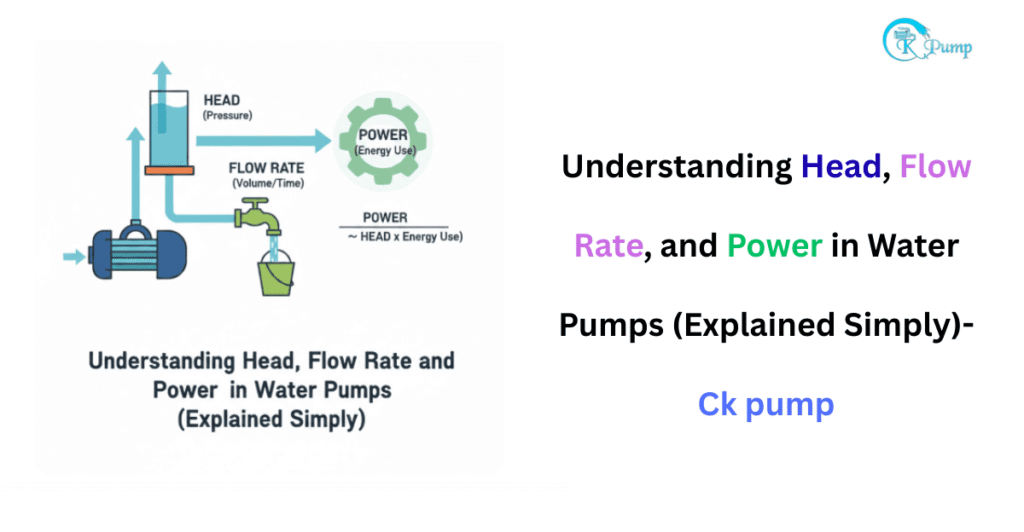
When people buy a water pump, most problems don’t come from poor quality—they come from wrong selection.
In almost every wrong selection case, three terms are misunderstood:
Head
Flow Rate
Power (HP / kW)
These are not technical buzzwords meant only for engineers. If you understand how these three work together, you can easily choose the right water pump for your application, whether it’s domestic, agricultural, or industrial.
This guide breaks everything down in simple language, with real-world logic—not textbook theory.
Why Head, Flow Rate, and Power Matter Together
Many users make this mistake:
“I need a 1 HP pump.”
But HP alone means nothing without head and flow rate.
A pump does not push water horizontally.
It lifts water against gravity and resistance, and that effort depends on:
How high the water needs to go (Head)
How much water you need (Flow Rate)
How much energy the pump must use to do both (Power)
Think of it like riding a bike:
Head = steepness of the road
Flow rate = speed
Power = your leg strength
You can’t judge performance by strength alone.
What Is Head in a Water Pump?
Head is the total vertical height the pump can lift water, measured in meters.
But here’s the important part:
Head is not just height.
It also includes pressure losses.
Types of Head You Should Know
Static Head
The actual vertical distance from water source to delivery point.Friction Head
Loss caused by:Pipe length
Pipe diameter
Bends, valves, elbows
Total Dynamic Head (TDH)
This is what really matters.
TDH = Static Head + Friction Losses
If your overhead tank is 15 meters high and your pipe losses add another 5 meters, your pump must handle at least 20 meters head.
Common Head Mistake
Many users select a pump rated at maximum head, not operating head.
If a pump’s max head is 30 meters, it does not mean it performs well at 30 meters.
Pumps work best in the middle of their head range, not at extremes.
What Is Flow Rate?
Flow rate tells you how much water the pump delivers over time.
It is measured in:
LPM (Liters per Minute)
LPH (Liters per Hour)
m³/hr (Cubic meters per hour)
Example:
60 LPM = 3,600 liters per hour
Why Flow Rate Drops as Head Increases
This is critical.
As head increases, flow rate decreases.
Every pump has a performance curve showing this relationship.
Low head → high flow
High head → low flow
There is no pump that gives maximum flow at maximum head.
If someone promises that, they’re selling you marketing—not engineering.
How to Decide the Right Flow Rate
Ask practical questions:
How many taps/showers/machines will run together?
How fast do you want the tank to fill?
Is it continuous operation or occasional use?
For example:
A home may need 30–60 LPM
Agriculture may need 200+ LPM
Industry depends on process load
Understanding Power (HP / kW)
Power is the energy required to deliver a specific flow rate at a specific head.
Measured as:
Horsepower (HP)
Kilowatt (kW)
Important Truth About Power
Higher HP does not automatically mean better performance.
Power increases when:
Head increases
Flow rate increases
Efficiency decreases
A poorly matched pump may consume more electricity while delivering less water.
Efficiency Matters More Than HP
Two pumps can both be 1 HP:
One delivers 50 LPM at 20 meters
Another delivers 80 LPM at the same head
Why?
Because of design and hydraulic efficiency.
This is why reputable manufacturers like CK Pump focus on optimized pump curves, not just HP ratings.
How Head, Flow Rate, and Power Work Together
These three are connected, not independent.
If you change one, the others change.
| Scenario | Result |
|---|---|
| Increase head | Flow rate drops, power demand rises |
| Increase flow rate | Requires more power |
| Poor pipe sizing | Increases head loss → higher power bills |
This is why pump selection must start with application data, not motor size
Reading a Pump Performance Curve (Simplified)
A pump curve shows:
X-axis → Flow rate
Y-axis → Head
The best operating zone is called the BEP (Best Efficiency Point).
Operating near BEP means:
Lower electricity consumption
Less vibration
Longer pump life
Running far from BEP causes:
Overheating
Seal failure
Motor damage
Real-Life Example
Application:
Overhead tank filling for a residential building
Vertical height: 12 meters
Pipe losses: 4 meters
Required flow: 40 LPM
Total Head Needed: 16 meters
Correct selection:
Pump whose curve delivers 40 LPM at ~16 meters
Power may be 0.5 HP or 1 HP, depending on efficiency
Wrong selection:
Choosing a 1 HP pump without checking curve
Leads to excess power consumption and poor output
Common Myths You Should Ignore
❌ “Higher HP means stronger pump”
❌ “Max head rating is what the pump will give daily”
❌ “One pump works for all applications”
❌ “Flow rate remains same at all heights”
Understanding the basics saves money, energy, and maintenance costs.
Why This Knowledge Matters Before Buying a Pump
If you match:
Correct head
Required flow rate
Efficient power rating
You get:
Lower electricity bills
Stable water pressure
Longer pump life
Fewer breakdowns
This is exactly why professional pump manufacturers design products around applications, not just motor sizes.
Final Takeaway
Before choosing any water pump, stop asking:
“How many HP is it?”
Start asking:
What is my total head?
What flow rate do I actually need?
At what point does the pump deliver both efficiently?
Once you understand how head, flow rate, and power work together, selecting the right pump becomes logical—not confusing.
If you want long-term performance, energy savings, and reliability, this understanding matters more than brand names or horsepower numbers.